Custom Furniture for corner: A Spice Wall That Turns
Custom Furniture for the kitchen corner works best as a rotating spice wall that turns on a hidden pivot, so you reach every jar without bending into a dead corner. In a typical HDB 4-room kitchen (about 90sqm flat), that awkward corner by the sink or hob is wasted space unless you build something that spins. A turning spice wall turns a forgotten 60cm corner into the most useful shelf in the house.
Why a corner spice wall beats a normal shelf
Corner cabinets are the classic spot where packets and bottles go to disappear. A fixed shelf leaves a deep triangle you can't reach. A turning unit fixes that with a simple swivel.
The build is a vertical column of shallow trays mounted on a central post. You give it a push and the whole stack rotates, bringing the back row to the front. It sounds gimmicky until you cook here every day and stop losing the cumin at the back.
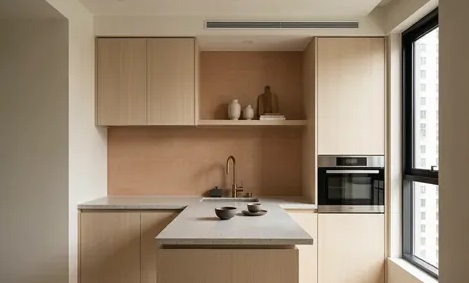
Unlike a pull-out carousel sold in shops, a custom one is sized to your exact corner and your exact jar heights. That matters because spice bottles come in all sizes, from flat Malaysian curry packets to tall Italian bottles.
What it costs and how long it takes
Budget roughly S$600 to S$1,200 for a custom turning spice wall, depending on height and the material you pick. That satays within a normal reno budget of S$30k to S$70k for a full HDB flat, so it's a small slice.
The timeline follows the usual custom job: measure, design, workshop build, then install. From measure to install you're looking at about 6 to 10 weeks. Build this into your reno schedule early so the carpenter isn't fitting it after the tiles are done.
If your kitchen is part of a bigger custom cabinet run, the spice wall can be made in the same batch, which trims cost a bit.
Custom Furniture materials that hold up in Singapore
Moisture is the enemy near any Singapore kitchen. Pick the carcass with that in mind.
Plywood is the safe pick: it resists humidity better than MDF and won't swell if a bottle leaks. Laminate faces are easy to wipe and come in dozens of finishes. MDF is cheaper but soaks up water, so skip it here. Solid wood looks lovely but moves with our weather and needs more care.
For the trays, a light laminate on plywood keeps the weight down so the pivot turns smoothly. Heavy solid wood trays make the unit harder to spin and strain the fittings.
Condo and HDB points to check
In an HDB BTO, the kitchen layout is fixed but you're free to add internal cabinets during the 1-year defect liability period, as long as you don't hack structural walls. The spice wall is non-structural, so it's fine.
In a condo, your MCST may have rules about works during certain hours and about dust control. Tell your contractor to follow the by-laws; a small cabinet job rarely needs approval, but a polite note to the management avoids friction.
Keeping it turning for years
Wipe the trays weekly with a damp cloth, not a soaking one. Every few months, check the pivot screw and tighten if it has loosened; a wobble is the first sign of trouble.
Don't overload each tray. Spread the weight so the column stays balanced. A turning wall that's stuffed to the brim becomes stiff and the fittings wear out faster.
On resale, buyers in Singapore notice smart storage. A kitchen with clever corner solutions reads as well-kept, and that helps when you eventually sell or rent the place out.
We built one of these for a client in a Tampines 5-room (around 110sqm) and the wife said she finally found her star anise. Small wins like that are why a turning spice wall is worth the effort. If your corner is dead space now, give it a spin.