Carpentry & Joinery Singapore: Sorting the right board
A Carpentry & Joinery in Singapore starts long before the first board is cut. Most owners underestimate how much the existing layout decides what is possible, and the same oversight shows up again and again.
Understanding plywood for wet areas in Singapore
The weak point of any board is the edge. Even plywood swells if the laminate edge peels, so ask for PVC or ABS edge banding that is glued and not just stuck on. In a landing where the dishwasher leaks, sealed edges buy you years. Pair the board with a backsplash that goes at least 600 mm up the wall and the cabinet legs stay dry.
How MDF and laminate options shape the final result
A fair compromise many owners pick: MDF carcass with a plywood base where the unit meets the floor. You get the smooth face and the water resistance where it counts, without paying full plywood price throughout. Ask the carpenter to spec the base separately so you are not guessing later.
Getting workshop and on-site building sorted early
Dust control is the part owners remember. A good team seals the work area, runs a vacuum sander, and clears at the end of each day. If you are living in during the build, this is the difference between a rough few weeks and a bearable one. Put the cleanup rule in the quote, not in hope.
A practical view of checking for defects
Edges reveal the build. A laminate that lifts at the corner, a mitre that does not meet, a panel with a chip at the kickboard, these are the tells. A careful carpenter fixes them before you see them; a rushed one hopes you will not. The check is your proof either way.
How hinges and soft-close fittings affect your schedule
Hardware is where cheap jobs fail first. A soft-close hinge that closes a door without a slam feels small but runs the daily life of a kitchen. Spec a concealed, adjustable hinge with a built-in damper, and use screwed inserts in particle board so the screw holds. The face looks the same; the feel gives it away in a year.
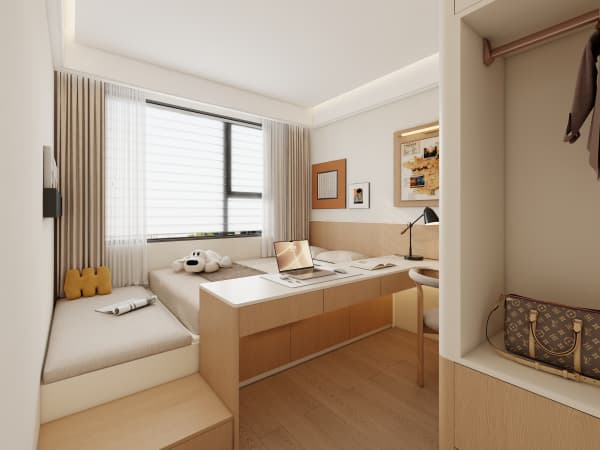
For an executive apartment in Clementi with a budget near S$28,000, the practical move is to fix the kitchen and the wardrobes first, because those are the spaces used every day, then phase the rest as the money allows.
What carpentry warranties cost you in the end
The warranty is only as good as the firm behind it. A sole proprietor who retires in two years leaves you with a paper guarantee. Prefer a registered company with a track record, and note the claim lead time. Some shops respond in days, others go quiet. A quick call to their office before you sign tells you which camp they are in.
Common questions about measuring for accuracy
Bring the floor finish into the measure. Tiles add 10 to 15 mm, a screed more. If the carpenter measures before tiling, the kickboard floats and the doors drag. Lock the floor height first, then measure, and the install meets the ground clean.
Where reading a quotation usually go wrong
A quotation should read like a bill of materials, not a single sum. Look for the board grade per cabinet, the edge type, the hinge brand class, the number of drawers, and the lighting. If an item is missing, assume the cheapest version, then decide. A clear quote also lists what is not included, like plumbing or hacking.
What custom versus ready furniture cost you in the end
Ready furniture wins on price and speed for the common pieces, and you can see it before you buy. The trap is forcing a standard size into a tight room and living with the gap. A mix works best: custom for the fixed walls, ready for the movable pieces you may take along.
The numbers matter: a an executive apartment with two bedrooms and a kitchen and a S$28,000 cap still gets a full plywood base and soft-close fittings if the owner cuts the face-grade and keeps the inside honest. The feel stays, the cost drops.
How joinery basics affect your schedule
Joinery also affects service. A joint that comes apart blocks the repair; one that is glued and screwed lets you swap a panel. Tell the carpenter you want repairable joints, not just neat ones. The home ages, and the joint that opens for service saves the piece.
Every Carpentry & Joinery in Singapore is a chain of choices, and the chain is only as strong as its weakest link. Get the permit, the plan and the people right, and the rest of the build takes care of itself.
One more point worth a line: keep the contact of the person who owns your project in a single note, with the quote, the permit and the warranty. When something needs a fix in year two, that note is what turns a denied claim into a quick visit. The paper you file today is the service you get later.
A small habit that pays off is to photograph the finished work at handover, before the furniture goes in. The shots show the edges, the gaps and the mitres as they should be, and give you proof if a fault appears after. Five minutes with a phone beats a week of argument about what changed.
Think about the next owner too. A clean, compliant build with the paperwork in order sells faster and for more, because the buyer's lawyer has fewer questions. The work you do for yourself also works for the resale, so treat the records as part of the asset, not just the receipt.
Do not chase the lowest number at the cost of the details. A job that saves on the edge banding and the hinge shows it within a year, and the fix costs more than the saving. Spend on the parts you touch daily, and the home feels right long after the photos are taken.
Finally, give the build a week before you judge it. Wood settles, doors find their rest, and a small adjustment at the start of use prevents a bigger one later. A carpenter who returns for the punch-list is worth more than one who disappears the day the balance is paid.
Match the build to how you actually live, not to a showroom you visited once. The kitchen you cook in and the wardrobe you open daily should reflect your routine, because a home that fits your habits is the one you stop noticing, and that is the highest praise a renovation can earn.