Carpentry Materials Singapore: Safe ideas for a BTO
A Carpentry Materials in Singapore starts long before the first board is cut. Most owners underestimate how much the existing layout decides what is possible, and the same oversight shows up again and again.
Understanding comparing board grades in Singapore
Boards split by core and grade. Plywood resists water, MDF takes a smooth face, particle board is the budget base. The grade, from ENF down through E0 and E1, marks the emission, not the strength, so read both. A board database helps you match the right core to the right room without guessing.
A practical view of MDF and laminate options
Medium-density fibreboard (MDF) takes a smooth laminate finish better than any other board, which is why it shows up in wardrobes and feature walls. It is stable and cheap to shape, but it drinks water, so it belongs in dry areas only. A plain laminate door on MDF costs less than a plywood equivalent and looks clean in a bedroom.
The numbers matter: a a resale 5-room flat with a service yard and a S$18,000 cap still gets a full plywood base and soft-close fittings if the owner cuts the face-grade and keeps the inside honest. The feel stays, the cost drops.
How typical carpentry budgets affect your schedule
If cash is tight, the renovation loan from HDB for flats can reach S$30,000 at about 5 percent, and banks offer similar amounts for private homes. Spread the big-ticket items, and keep a 10 percent buffer for the changes you will inevitably want once the walls come down. Few renovations end at the first quote.
How hinges and soft-close fittings shape the final result
Hardware is where cheap jobs fail first. A soft-close hinge that closes a door without a slam feels small but runs the daily life of a kitchen. Spec a concealed, adjustable hinge with a built-in damper, and use screwed inserts in particle board so the screw holds. The face looks the same; the feel gives it away in a year.
A practical view of carpentry warranties
The warranty is only as good as the firm behind it. A sole proprietor who retires in two years leaves you with a paper guarantee. Prefer a registered company with a track record, and note the claim lead time. Some shops respond in days, others go quiet. A quick call to their office before you sign tells you which camp they are in.
Getting particle board value sorted early
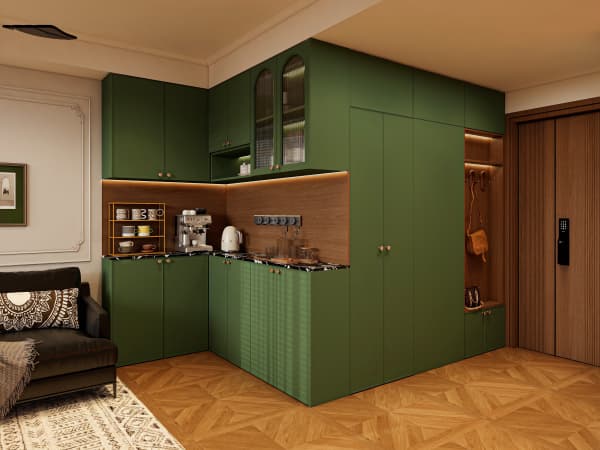
Do not put particle board where it gets wet. A spill on a particle board base cabinet spreads fast and the board crumbles. If budget forces particle board in the kitchen, at least specify plywood for the sink base and the kickboard. The small upgrade prevents a full rebuild two years on.
Understanding plywood for wet areas in Singapore
Owners often ask whether plywood is worth the premium over particle board. For the lower cabinets and any unit touching the floor or a water source, yes. For tall pantry cabinets in a dry store room, a quality particle board does the job at lower cost. Match the board to where it sits, and you get the same lifespan for less.
A practical view of low-emission board choices
Indoor air in a sealed Singapore flat matters, so board grade is a health call, not just a price. Look for E0 or ENF rated boards, which emit the least formaldehyde, and ask the carpenter for the test certificate, not just the label. The difference shows in the first weeks after install, when a poor board smells and a good one does not.
For a 4-room BTO flat in Yishun with a budget near S$28,000, the practical move is to fix the kitchen and the wardrobes first, because those are the spaces used every day, then phase the rest as the money allows.
A practical view of custom versus ready furniture
Ready furniture wins on price and speed for the common pieces, and you can see it before you buy. The trap is forcing a standard size into a tight room and living with the gap. A mix works best: custom for the fixed walls, ready for the movable pieces you may take along.
What indoor air and board grade cost you in the end
Ventilation closes the gap. After install, run a fan for a week and sleep elsewhere if you can. The smell test is real: a persistent chemical tang means a board or glue below standard. Push the supplier for the cert, and if they hesitate, walk. The cheap board is never cheap once the window stays shut.
The real win from a Carpentry Materials in Singapore is a home that fits how you live, not how a showroom looks. Build to your habits, keep the paperwork, and the daily use will thank you for years.
One more point worth a line: keep the contact of the person who owns your project in a single note, with the quote, the permit and the warranty. When something needs a fix in year two, that note is what turns a denied claim into a quick visit. The paper you file today is the service you get later.
A small habit that pays off is to photograph the finished work at handover, before the furniture goes in. The shots show the edges, the gaps and the mitres as they should be, and give you proof if a fault appears after. Five minutes with a phone beats a week of argument about what changed.
Think about the next owner too. A clean, compliant build with the paperwork in order sells faster and for more, because the buyer's lawyer has fewer questions. The work you do for yourself also works for the resale, so treat the records as part of the asset, not just the receipt.
Do not chase the lowest number at the cost of the details. A job that saves on the edge banding and the hinge shows it within a year, and the fix costs more than the saving. Spend on the parts you touch daily, and the home feels right long after the photos are taken.
Finally, give the build a week before you judge it. Wood settles, doors find their rest, and a small adjustment at the start of use prevents a bigger one later. A carpenter who returns for the punch-list is worth more than one who disappears the day the balance is paid.