Carpentry Materials Singapore: Starting in Bukit Batok
Owners who have done a Carpentry Materials in Singapore tend to agree on one thing: the part they rushed is the part they redo. Taking the time up front is the cheapest insurance in the whole project.
Where indoor air and board grade usually go wrong
Air quality is a system, not one product. Low-emission board plus a low-VOC edge glue plus a week of airing beats any single premium buy. Ask the carpenter for the glue grade too, because a great board with a poor adhesive still off-gasses. The whole chain must be clean.
In Simei, a a 4-room BTO flat often comes with an awkward service yard, and the build that works treats it as a second kitchen rather than a dump. A S$50,000 budget stretches further when the yard pulls its weight.
Understanding typical carpentry budgets in Singapore
Carpentry in a Singapore home spans a wide range. A basic kitchen and a couple of wardrobes can land at S$8,000 to S$12,000, while a full-home build with plywood, soft-close hardware and a feature wall often reaches S$25,000 to S$40,000. The board grade and the amount of custom work move the number more than the room count.
For a landed intermediate terrace in Sengkang with a budget near S$60,000, the practical move is to fix the kitchen and the wardrobes first, because those are the spaces used every day, then phase the rest as the money allows.
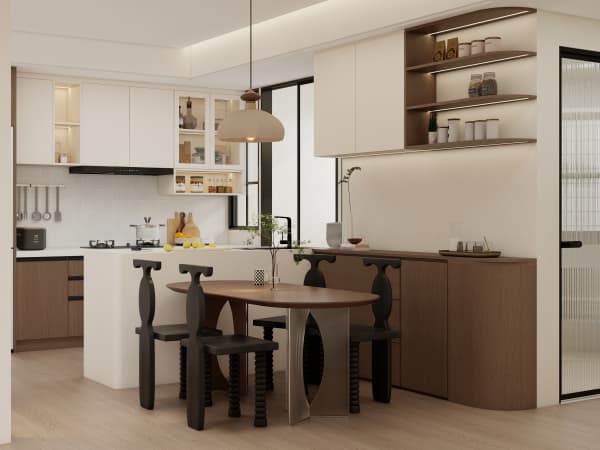
Understanding particle board value in Singapore
The trick with particle board is the hardware. Because the core is soft, hinges and hinges screws need the right fittings or the holes wallow out. Use screwed-in inserts rather than driving straight into the board, and the doors stay put. Most warranty claims on particle board come from bad fixing, not bad board.
Understanding custom versus ready furniture in Singapore
Custom beats ready when the space is odd or the need is specific. A built-in that wraps a bay window or fills a 1.2 m alcove uses space a shop piece wastes. For standard items like a bed or a side table, a bought piece often costs less and ships faster. Match the method to the gap.
Common questions about comparing board grades
Price follows grade and origin. A branded E0 plywood costs more than a generic E1, and the gap is real in a sealed room. Use the database to set a floor: pick the lowest grade that meets your air and water needs, then spend the saving on hardware where it shows.
How carpentry warranties shape the final result
Keep a record of the board grade, the hinge type and the invoice dates in a single file. When a drawer runner fails in year two, that file is what the carpenter needs to honour the claim without argument. Five minutes of notes today saves a long search and a denied claim three years on.
Getting hinges and soft-close fittings sorted early
Brand class is matters less than the spec and the fix. A mid-range hinge set properly beats a top name driven into a soft core. Ask the carpenter which hinge and which runner, by load rating, and write it down. The hardware line on the quote is where you learn the true quality.
Where plywood for wet areas usually go wrong
The weak point of any board is the edge. Even plywood swells if the laminate edge peels, so ask for PVC or ABS edge banding that is glued and not just stuck on. In a landing where the dishwasher leaks, sealed edges buy you years. Pair the board with a backsplash that goes at least 600 mm up the wall and the cabinet legs stay dry.
Understanding low-emission board choices in Singapore
Low-emission board costs a bit more but the spend is front-loaded into the build, where it counts. Pair it with a low-VOC adhesive and let the home air for a week before you sleep there. A simple fan and an open window beat any spray sold as a cure.
A practical view of MDF and laminate options
Medium-density fibreboard (MDF) takes a smooth laminate finish better than any other board, which is why it shows up in wardrobes and feature walls. It is stable and cheap to shape, but it drinks water, so it belongs in dry areas only. A plain laminate door on MDF costs less than a plywood equivalent and looks clean in a bedroom.
A Carpentry Materials in Singapore succeeds when the small calls are made well. The right board at the sink, the soft-close where you open daily, the layout that respects the work triangle, these are the marks of a build done right.
One more point worth a line: keep the contact of the person who owns your project in a single note, with the quote, the permit and the warranty. When something needs a fix in year two, that note is what turns a denied claim into a quick visit. The paper you file today is the service you get later.
A small habit that pays off is to photograph the finished work at handover, before the furniture goes in. The shots show the edges, the gaps and the mitres as they should be, and give you proof if a fault appears after. Five minutes with a phone beats a week of argument about what changed.
Think about the next owner too. A clean, compliant build with the paperwork in order sells faster and for more, because the buyer's lawyer has fewer questions. The work you do for yourself also works for the resale, so treat the records as part of the asset, not just the receipt.
Do not chase the lowest number at the cost of the details. A job that saves on the edge banding and the hinge shows it within a year, and the fix costs more than the saving. Spend on the parts you touch daily, and the home feels right long after the photos are taken.
Finally, give the build a week before you judge it. Wood settles, doors find their rest, and a small adjustment at the start of use prevents a bigger one later. A carpenter who returns for the punch-list is worth more than one who disappears the day the balance is paid.
Match the build to how you actually live, not to a showroom you visited once. The kitchen you cook in and the wardrobe you open daily should reflect your routine, because a home that fits your habits is the one you stop noticing, and that is the highest praise a renovation can earn.