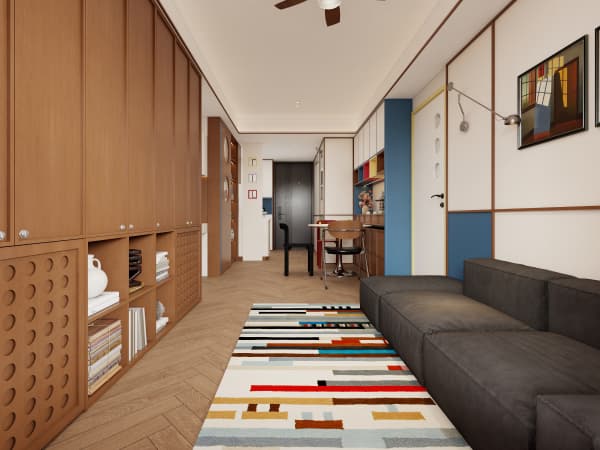
Custom Furniture at helper room: Quieting Your Built-ins
Custom Furniture in a helper's room should be quiet as well as practical, because a rattling built-in keeps the person sleeping there awake and wears on everyone. In a small helper room, a noisy wardrobe or shelf is amplified, so silencing it is part of building it right.
Why noise matters in a helper room
Helper rooms in Singapore flats are compact, often 6 to 9 sqm, with the bed close to the storage. A door that clicks, a drawer that rattles, a panel that hums when the neighbour's unit vibrates — all of it lands loud in a small room.
Quiet built-ins show basic respect for the person who lives there. It's also just better carpentry. A silent room is a sign the build was done with care.
Where the noise comes from
In a 4-room HDB (about 90 sqm) or 5-room (around 110 sqm), the helper room often backs a bathroom or the service yard, so pipe and fan noise travels. The built-ins then add their own:
Loose hinges that tap when the door shuts.
Unbraced panels that resonate against the wall.
Hard edges that knock together as the building settles.
How we quiet the built-ins
Silence is built in, not added later:
Soft-close hinges. Doors ease shut with no slam, the single biggest win.
Felt buffers. We line where panels meet so nothing taps in the night.
Braced backs. A fixed back panel stops the resonance you feel more than hear.
Level feet. On uneven floors, adjustable feet stop a unit from rocking and groaning.
Custom Furniture that respects the room
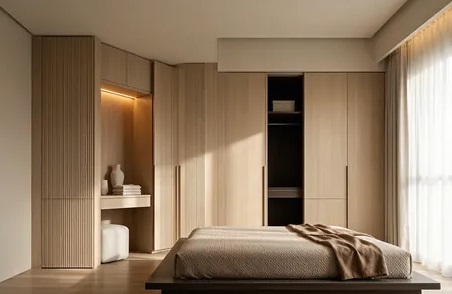
Custom Furniture for a helper room should give real storage without crowding the bed. We keep the run slim, leave knee and head clearance, and make sure the doors don't swing into the sleeping space. A room that breathes is a room that stays quiet.
We also avoid glass or metal trims that ring. Matte laminate and soft plywood read calmer than shiny surfaces in a small bedroom.
Materials that stay calm
The board choice affects sound and feel:
Plywood is dense and quiet, our pick for helper-room built-ins.
Laminate faces wipe clean and don't echo like bare surfaces.
MDF is acceptable for carcasses but pair it with soft-close to avoid rattle.
Solid wood is fine but seal it well in our humidity to stop movement noise.
Cost, timeline and approvals
A quiet helper-room built-in runs roughly S$1,000 to S$2,500. Within a full reno of S$30k to S$70k, it's a modest piece.
From measure to install, plan about 6 to 10 weeks. HDB work carries a one-year defect liability period, so a door that starts tapping in the first year gets fixed under that cover — though with soft-close fitted, it usually won't.
Upkeep and resale
Tighten hinges every few months and replace felt buffers if they flatten. A five-minute check keeps the room silent.
At resale, a calm, well-built helper room reads as a proper living space, not a storage afterthought. Buyers with live-in help notice this immediately. Keep it neutral and tidy.
The honest point is that a helper room deserves the same care as any bedroom. Build the storage quiet, give it soft-close and bracing, and the person sleeping there gets rest. Good carpentry is considerate carpentry.