Custom Furniture by study desk: A Crate Stack That Rolls
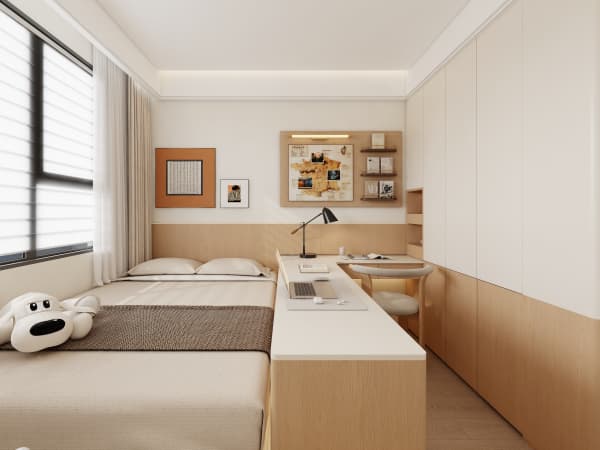
Custom Furniture beside the study desk works best when it moves with you, and a rolling crate stack is the simplest flexible storage for a tight Singapore room. The fix for a cramped study corner is rarely a bigger desk — it is storage that rolls out of the way when you need floor space and tucks back when you don't. Most HDB bedrooms sit within a 4-room flat of roughly 90 square metres, so every centimetre of clear floor counts.
Where Custom Furniture Beats a Store-Bought Shelf
A flat-pack cube shelf looks cheap until you realise it won't sit flush against an uneven HDB wall and blocks the window you need for light. Bespoke carpentry lets the crate stack follow the room's real dimensions — shallower where the ceiling slopes, recessed where a beam drops, sized so the castors never catch the chair. You decide the opening heights: picture books low, stationery trays mid-level, the console tucked high. A freestanding unit that topples is a hazard in a child's room; a made-to-measure piece anchors to the wall studs yet still rolls on locking castors when you vacuum.
Sizing the Crate Stack for an HDB Study Corner
Start with the chair. A study chair needs about 60 centimetres of pull-out space, so the stack should sit to the side or in front of a window wall rather than behind the seat. For a primary schooler, build the lowest crate no more than 35 centimetres off the floor; for a teenager, push the body higher and use the rolling base for the printer. In a 5-room flat, closer to 110 square metres, the common room doubles as study and guest bedroom — the stack can grow to about 1.8 metres and hold study gear plus bedding, while a fold-down desk keeps the floor clear for visitors.
- Depth: keep crates 30–35 cm deep so books don't disappear into the back.
- Width: 60–80 cm fits between a window and the room corner in most HDB layouts.
- Height: stop at 1.5 m for a child's room, 1.8 m where ceiling clearance allows.
Materials That Survive a School-Year Beating
For a piece that takes daily yanking and the odd juice spill, plywood is the honest choice — it holds screws at the edges and shrugs off Singapore's humidity swings far better than MDF. MDF is smoother and cheaper and paints beautifully, but it swells permanently once water sits on an unsealed edge, so it is risky near a water bottle. Solid wood lasts decades but moves with humidity and costs far more; a rolling stack dragged around can eventually loosen its joints. Ask for PVC or ABS edge banding on the fronts rather than raw veneer tape, which peels within a year of rough use.
Castors, Clearances and the Condominium Noise Window
In a condo, the MCST by-laws forbid hacking structural walls, and noisy work is generally restricted to roughly 9 am to 5 pm on weekdays. Installing a rolling stack is light work, but if the carpenter must drill to anchor it, schedule it within that window and warn the neighbour. Choose castors with a brake and a rubber tyre — hard plastic marks parquet and clicks on tile, while rubber rolls quietly. Leave a 5-centimetre gap so the brake is reachable and the paint isn't scuffed.
A Reasonable Budget and What to Expect
A single rolling crate stack in plywood, about 70 cm wide and 1.5 m tall with four braked castors, typically costs S$600–S$1,200 depending on crate count and edge finish. That is a small slice of a full HDB renovation, which usually runs S$30k–S$70k by scope, and lead time is roughly 6–10 weeks from measurement to installation. Most carpenters give a one-year defect warranty covering loose castors, sticking drawers and peeling edges; it rarely covers flooding or the unit being dragged down stairs, so keep the brakes on when parked on a slope.
The payoff is simple. When homework is done, the crate stack rolls into the corner and the room opens up again — no permanent footprint, no wasted wall, just storage that gets out of the way. Build it once, sized to the room and the child, and it will outlast the syllabus.