Custom Furniture for desk: A Recycling Bay Tall
Custom Furniture for a home desk works best when you fold the recycling bay into the same run of carpentry, and a tall pull-out unit beside the workstation is the simplest way to keep Singapore's sorting habit going without stealing floor space. In a typical HDB 4-room flat of roughly 90 sqm the few square metres around the study corner are contested, so letting the cabinet do the sorting spares you the daily walk to the void-deck blue bin.
Custom Furniture for the recycling bay earns its keep in plywood
Most 4-room flats give you a combined living-dining stretch of about 9 to 11 metres of wall, but the TV feature wall, the shoe cabinet and the study nook all want a slice of it. The recycling bay does not need the front wall. Tuck it at the end of the desk run, against the party wall by the household shelter, where a 35 to 45 cm deep column reads as part of the carpentry rather than an add-on. Keep the top of the bay below 2 metres so it does not crowd the service trunking, and leave a 5 cm gap behind for the HDB-approved power point that runs your shredder or label printer.
A "tall" bay means roughly 1.8 to 2.1 metres, which is enough for four to five sorted compartments: paper, plastic, glass and a small e-waste drawer at the bottom. Go deeper than 45 cm and you lose walking clearance in a flat this size; shallower than 30 cm and the large HDB carton boxes will not sit flat. Ask the carpenter to put the heaviest bin, glass, at the base so the unit never tips, and fit soft-close runners rated for at least 35 kg so a full glass bin still slides on one hand.
Why moisture-resistant board beats MDF next to wet waste
This is where the plywood-versus-MDF choice stops being academic. Recycling contents in Singapore's humidity sweat condensation: a rinsed soy-sauce bottle, a damp milk carton, a leaky detergent refill. MDF soaks that up and balloons at the base within a year, while structural plywood with a phenolic or laminate face shrugs it off. Pay for MR, moisture-resistant, plywood at least 12 mm thick on the bin carcass, and skip solid wood here unless you enjoy re-oiling a cabinet that lives three centimetres from a mop. The desk top itself can be anything you like, but the bay that touches wet waste should be the tougher board.
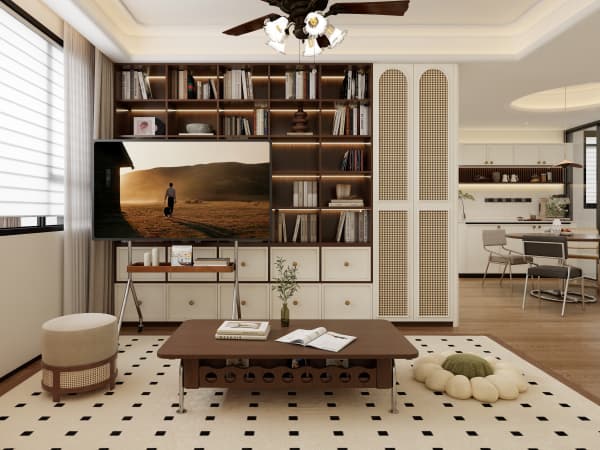
One more honest trade-off: MR plywood costs roughly 20 to 30 percent more than plain MDF, and a full tall bay in MR plywood will land around S$900 to S$1,400 depending on the number of pull-outs and the edge profile. If the budget is tight, build the desk in MDF-laminate and only the recycling carcass in MR plywood. Nobody sees the mix, and you have spent the money where it actually rots.
Reach height and the liner detail people skip
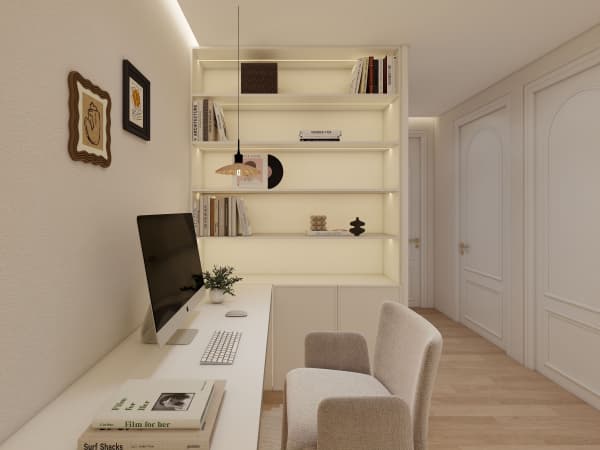
The desk should sit at about 74 to 75 cm, the local standard for a seated workstation with a 45 to 65 cm deep top. Put the recycling pull-outs to the side of the desk, not under it, so you are not bending into a knee well to toss a can. The most-used compartment, paper and plastic, wants to sit between 60 and 110 cm off the floor, roughly elbow height when you are standing, so a quick sort does not become a squat. The e-waste drawer can go low, near the floor, because you only open it when a phone or cable actually dies.
The detail people miss is the liner. A tall bay sealed at the back still traps odour if the bins sit on bare board. Cut a removable tray from an old chopping board or ask for an ABS tray insert, and you can wipe the base monthly instead of sanding mould. Whole-home custom carpentry in a 4-room typically runs S$30k to S$45k; a dedicated desk-plus-recycling bay is a small, high-use slice of that, and getting the liner right is the difference between a bay you keep and a bay you stop opening.
Build the bay as part of the desk commission, agree the MR plywood in writing, and you end up with sorting that lives in the room instead of a chore you avoid. The flat stays tidier, the void-deck trip shrinks to a weekly carry, and the desk keeps its clear top because the waste already has a home.