Custom Furniture of landing: A Larder That Swings Out
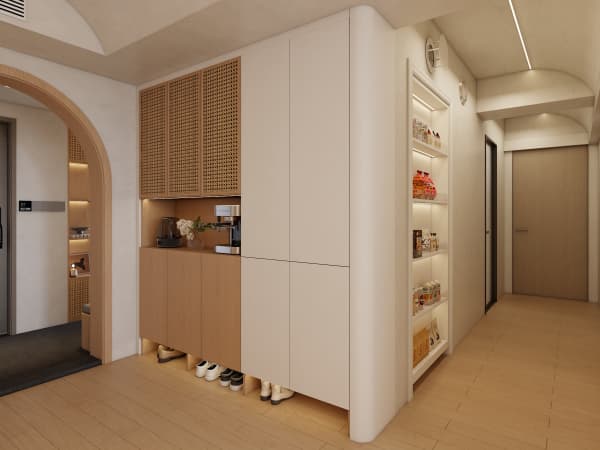
Custom Furniture built as a swing-out larder is the piece that rescues a dead landing — a tall cabinet hinged at one side that opens to reveal deep racks swinging clear of the passage, turning the awkward corner where the stair meets the hall into a proper dry-store without blocking the walkway.
The swing-out larder on a tight landing
Landings in Singapore homes are usually leftover space — the turn at the top of an HDB stair, the half-landing of a landed home, or the narrow hall where a storeroom door would swing into someone. A standard larder needs a door that opens into the room, and on a landing there is no room for the swing. A swing-out larder hinges the whole cabinet body, so it pivots from the wall and the racks come to you while the passage stays clear behind it.
The payoff is bulk storage without a second fridge or a stuffed kitchen. Landing space is cool and dark, ideal for biscuits, paper goods, medicines, and the helper's supplies, all of which otherwise crowd the kitchen cabinets. A swing-out unit puts a full-height store on a wall you were only walking past, and because it closes flat, the landing looks untouched.
It also keeps the stair safe. A landing littered with a trolley and cartons is a fall risk, especially at night. Tucking everything into a closed swing-out cabinet returns the floor to the stair and removes the clutter that collects on a flat ledge. For families with elderly parents, that clear landing is a genuine safety win.
Planning this Custom Furniture for a landed-home landing
Landed homes often have a wider half-landing than an HDB, which is where this shines. The wall beside the stair is usually internal and non-structural, so a built piece can be screwed to the studs without touching the party wall or any load-bearing element. Measure the clear swing arc: the cabinet must open fully without hitting the handrail or the opposite wall, and on a tight HDB landing that arc is the limiting factor that decides the depth.
Depth should follow the swing, not the wish list. A 30-centimetre-deep body holds pantry racks and tall bottles; push to 40 centimetres only if the landing arc allows it, because a deeper unit needs a wider pivot and more clearance behind. The maker should mock the open position on site so you see exactly how much floor it claims when loaded, not just when closed.
Lead time is the standard 6 to 10 weeks from measurement to install, typical of Singapore carpentry. In a landed renovation that can run well past a usual HDB budget, fold the larder into the main build so it matches the other stair carpentry. Ordering it alone later means a second measurement, a second fee, and likely a slightly different finish.
Hinges, load, and the warranty to expect
The pivot is the whole game. A swing-out larder needs a heavy-duty piano or pivot hinge rated for the loaded weight — often 40 to 70 kilograms once stocked — not a cabinet door hinge borrowed for the job. Spec stainless or coated fittings because landings near an external door catch humidity and the metal will rust if it is cheap. A weak hinge is the failure every owner regrets, so name the rating in the quotation.
Material choice follows the load and the location. Plywood carcasses are the right call: stable, lighter than solid wood, and stronger across a tall span than MDF, which sags and can crumble at the edges if knocked. A laminate face wipes clean and shrugs off the occasional delivery-bag scrape. Solid wood is lovely but adds weight you do not want on a pivoting hinge and costs more than the function justifies.
Confirm a one-year defect warranty in writing before paying. It should cover hinge failure, warped panels, and finish faults — and on a pivoting unit, a failing hinge is a safety issue, not a cosmetic one. The standard year of cover in Singapore carpentry is your baseline; hold the contractor to it and keep the quotation noting the hinge rating, so there is no dispute if the swing goes stiff after a few humid months.
A swing-out larder is the kind of landing fix you appreciate every grocery run. Map the swing arc, keep the depth honest, choose plywood on a rated pivot, and book it with the main build. Built once, it turns dead corner into the most useful store in the house.