Custom Furniture with cabinet: Easy Reach and Safe Heights
Custom Furniture built around your wall cabinets lets you grab daily items without a step stool, and keeps risky things up high. The fix is mostly putting the right object at the right height.
Why Custom Furniture Matters in a Small Flat
Most HDB flats are tight. A 4-room flat is about 90sqm and a 5-room sits near 110sqm, so every vertical centimetre counts. When cabinets sit at awkward heights, you either strain or leave whole shelves empty.
Custom furniture fixes this by matching shelf heights to the people who actually use the space. Many ready-made units come in fixed sizes built for a taller, standard user, which leaves shorter folks stretching every day.
Plan the zones and safe heights
List what lives in each cabinet, then split items into three reach bands:
Eye to hip level – daily items: plates, mugs, snacks, the medicine you take often.
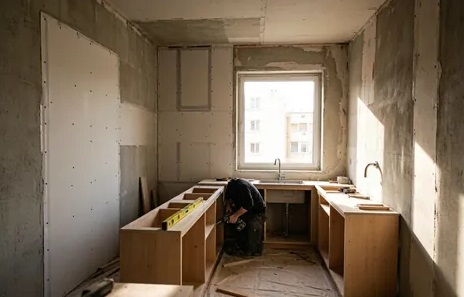
Hip to shoulder – weekly items: rice, blender, party ware, spare towels.
Above shoulder or below knee – rarely used: festive décor, documents, bulky pots.
This banding tells the workshop where to put drawers versus doors. Drawers beat deep shelves for things you grab often, because you pull the contents out instead of digging.
If you have young children, keep cleaning liquid, sharp tools, and step stools in upper cabinets with child-proof latches. The latch is cheap, roughly S$3 to S$10 per fitting. For upper cabinets, a comfortable landing shelf sits about 1.5m from the floor for an adult; drop the main work shelves to 1.1m to 1.3m if the main cook is shorter or uses a wheelchair.
Materials that hold the weight
Cabinet carcasses in Singapore usually come in three builds. Plywood is sturdy and shrugs off humidity, a real plus in our climate, though it costs more than MDF. MDF with laminate is smooth and budget-friendly but sags if it stays damp. Solid wood looks warm and lasts, yet it moves with humidity and needs care.
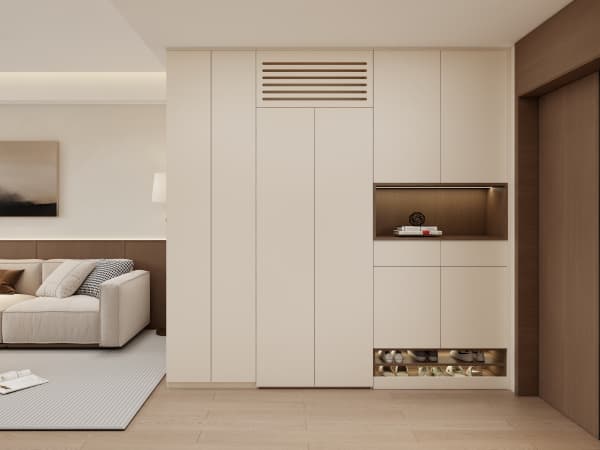
For doors, laminate over plywood gives the most reliable finish for the price. Avoid placing solid wood near the hob or a west-facing window where heat builds up through the afternoon. In 2025-2026, more local homes are picking handleless fronts and warm two-tone laminates for a calmer, less busy look.
Cost, timeline, and the rules
A focused cabinet project for one room often lands between S$3k and S$9k, depending on material and hardware. Full-kitchen custom cabinetry with fittings can reach S$12k to S$20k.
From measure to install, plan for roughly 6 to 10 weeks. That covers site measurement, 3D drawings, workshop build, and delivery. Most HDB renovation packages include a 1-year defect liability period, so flag any soft-close hinge or alignment issue early. For the wider picture, a full HDB renovation in Singapore typically runs S$30k to S$70k, so a cabinet job is one slice of that budget.
In a condo, your MCST may require approved plans before hacking or fixed carpentry near common walls. Some buildings also restrict work to weekdays and ban noisy jobs on weekends. Check the by-laws before you sign, because the delay lands on you, not the workshop.
Care and resale
Wipe laminate with a damp cloth, not a soaking wet one. Tighten hinge screws every few months, since our humidity swells and shrinks timber slightly through the year. A small tube of drawer wax costs under S$10 and fixes most gripes.
On resale, a tidy, well-planned cabinet layout reads as "less work" to the next owner. You won't recover the full spend, but buyers notice a kitchen where everything has a place.
At the end of the day, cabinets that match your reach and your household's heights just make the flat easier to live in. Measure twice, store by habit, and you'll stop climbing for the cereal.