Custom Furniture with nook: Zoning Without Walls
Custom Furniture with a built-in nook zones an open Singapore home without putting up a single wall, because a made-to-measure window seat, reading corner or bay-window bench marks a "room within a room" using storage and seating alone — and that keeps the flat's approved layout intact while still giving the eye a place to land.
Why Custom Furniture Zones Better Than a Partition
Both HDB and condo rules are cool on makeshift walls. HDB warns against carving extra "bedrooms" out of open plans, and most condo MCSTs require management approval for any fixed partition because it changes the unit's submitted plan and can affect fire egress. A nook sidesteps all of that. It is carpentry, not construction: a bench that hugs the bay window, a bookshelf that stands perpendicular to the wall, a banquette that says "dining starts here" without a wall saying it. You get the feeling of zones — work, rest, eat — with nothing touching the ceiling or the building's structure.
The second advantage is the floor. A partition eats square metres from both sides; a nook returns them as seating and storage. The bay-window bench you build becomes the reading chair you did not have to buy, plus the toy drawer you did not have to find.
The bay window nook done right
Most HDB flats arrive with a bay window — a recessed ledge with a fixed granite top you cannot hack or remove. The instinct is to leave it as a dead plant shelf. Instead, build a custom seat and cabinets around it: a cushioned top at chair height (about 42 centimetres) over a row of drawers, with open shelves on either side for books. The original granite stays; you dress it, you do not destroy it. In a 4-room living room of roughly 90 square metres, that nook recovers a whole seating zone without shrinking the walking space.
Two honest notes. The bay window is often the coolest, draughtiest spot in the flat, so use a washable cushion and a plywood (not MDF) base if the ledge sees condensation. And keep the window operable — do not build the seat so high it blocks the slide, or you lose the only cross-breeze the living room gets.
- Build around the bay, never into the granite — HDB owns that ledge.
- Cushion at 40–45cm so it reads as a seat, not a table.
- Leave the window slide clear for cross-ventilation.
A reading or work nook in a dead corner
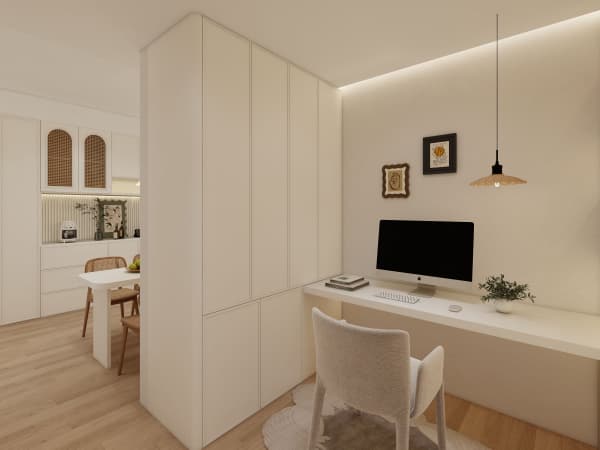
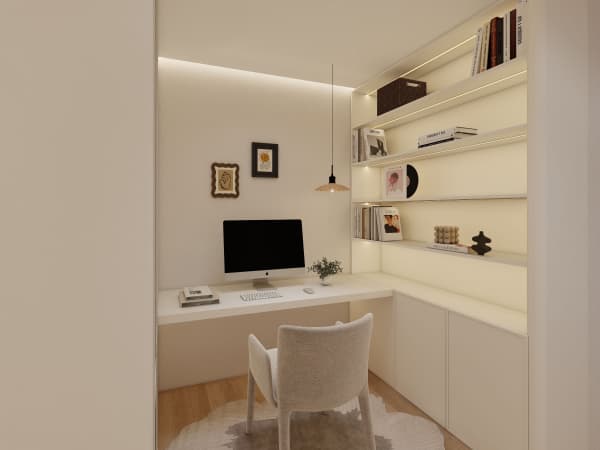
Every Singapore flat has a corner the sofa will not fill — by the bomb shelter, behind the door, under the air-con ledge. A custom nook turns it into a reading chair with a bookcase overhead and a power point tucked into the side for a laptop. Because it is made to the exact awkward dimension, the corner stops being wasted and starts being the quietest seat in the house.
For a work nook, add a fold-down leaf so the "desk" disappears when the laptop closes; the room stays a living room, not a permanent office. Run the data point during renovation, not after, because chasing a cable through finished nook carpentry means pulling the back panel you just paid for.
Material and the cost of going wall-free
Indoor nooks are MDF-laminate territory, S$60 to S$90 per square foot run, with plywood (S$90 to S$140) only where the seat will take daily weight or sit near a bathroom wall. A window banquette with storage typically runs S$2,500 to S$5,500 by scope; a corner reading nook less. Lead time is the usual six to ten weeks, so include the nook in the first carpentry order rather than as a "later" add-on you never get around to.
A home zoned by furniture, not by walls, stays bright, stays legal, and stays flexible when the kids grow and the nook becomes a study. Measure the awkward corner, build the seat, and let the room divide itself.