HDB Renovation Guide Singapore: Wardrobe Storage That Works
This HDB Renovation Guide Singapore helps you build wardrobe storage that fits a small flat in 2025 and 2026. The takeaway: go built-in and full-height to grab every inch, and pick E0 boards so your clothes don't sit in off-gassing smell. Plan the inside before the doors.
Wardrobe storage that works
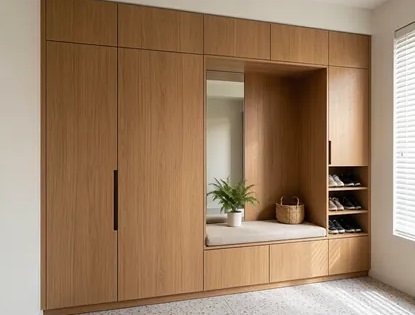
Built-in beats freestanding in an HDB flat. A freestanding piece leaves gaps top and sides that collect dust and waste space. Built-in runs wall to wall and floor to ceiling, so you use all of it. It also reads cleaner in a small room.
Top-hung wardrobes fix to the wall and free the floor, which makes a room feel bigger and easier to clean. Floor-standing ones are heavier and can trap mould underneath in our humidity. Sliding doors save swing space in a tight common room. Casement doors open fully but need clearance.
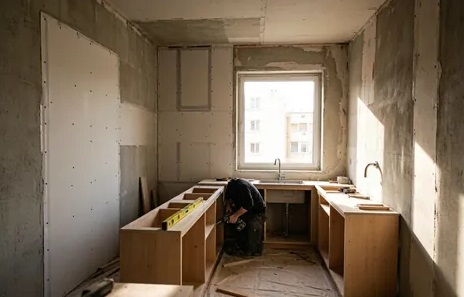
Custom carpentry is where this lives. Since carpentry is about 40% of a reno budget, your wardrobe is a real cost line. Spend it on the inside layout, not just the face. Drawers for folded items, hanging for shirts, and a tall bay for dresses do more than a pretty front.
Think about the build order:
- Measure the wall and decide top-hung or floor-standing.
- Sketch the inside: hang, fold, and hidden zones.
- Pick sliding or casement based on clear floor space.
- Choose board grade and hardware before the workshop cuts.
Maximising a 3-room or common room
A 3-room flat gives you one common room, so it must multitask. A study-cum-wardrobe combo puts a desk against one wall and the wardrobe on the other, splitting the room without a partition.
Loft beds free the floor below for a wardrobe or study. I've seen a 3-room common room fit a double loft, a full wardrobe, and a desk by going up. Full-height units along the windowless wall squeeze the most from a box room.
- Study-cum-wardrobe combos for one shared room.
- Loft beds to open floor space below.
- Full-height units on the longest clear wall.
- Shallow cabinets in the corridor for out-of-season wear.
Materials and durability
Board grade is the part owners skip and regret. E0 boards emit the least formaldehyde, E1 is the minimum you should accept. Cheap boards smell for months and that's your clothes absorbing it. In a humid country, this choice matters more than the colour.
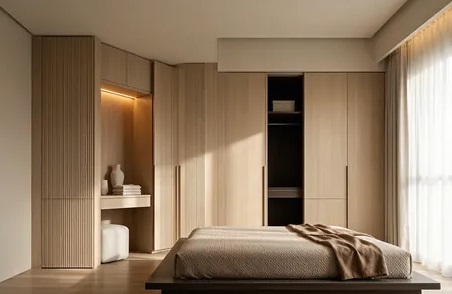
Edge banding seals the board so moisture doesn't swell it. Poor banding peels within a year and the carcass soaks up our air. Soft-close hinges and runners keep doors aligned and quiet, and they survive daily yanking better than fixed ones.
Ventilation stops mould. Leave a small gap behind built-ins or add a vent if the back sits on an external wall. I've pulled wardrobes off walls black with mould because the owner sealed them flush. A little air flow saves the fabric and the board.
Build in, go full-height, and pick E0 boards with proper banding and soft-close gear. Vent the back so Singapore's humidity doesn't rot it. Do that and your wardrobe holds up for the years you'll actually live with it.