Custom Furniture Edges: Rounded Profiles for Busy Homes
For Custom Furniture in a busy Singapore household, rounded edges are the safer, kinder choice. They don't chip as easily, they don't hurt when a child runs past, and they wipe clean. Square, sharp profiles look crisp in a showroom but take the first knock badly. Soften the edge and you protect the piece and the people.
Why the edge gets hit first
Think about where damage happens. It's rarely the flat face — it's the corner that meets the hallway, the lip of the TV console, the front of a low cabinet at toddler height. A sharp 90-degree edge chips the moment a vacuum or a school bag swings into it. A rounded or chamfered profile turns that hit into a graze.
In a 4-room HDB of roughly 90 sqm, circulation space is tight. Furniture edges sit close to walking lines, so the profile you pick gets tested daily.
Edge profiles, in plain terms
You don't need the trade names. Picture the shape.
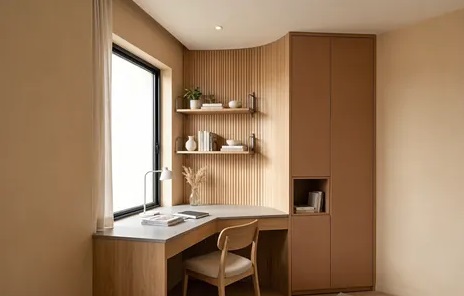
- Square edge — clean line, but the most fragile and the hardest corner.
- Rounded (bullnose) — fully soft curve, safest for kids and the easiest to clean.
- Chamfer — a small 45-degree bevel, a compromise that looks tidy and sheds knocks.
- Half-round or pencil — a slight soften, enough to kill the sharpness without changing the look much.
For a home with young children, I'd put bullnose on anything below 900mm. For adult-only spaces, a chamfer keeps the modern line while taking the sting out.
How the edge is made
On laminate work, the edge is a PVC or acrylic band glued and trimmed flush. A rounded profile means the band itself is shaped, not just a thin strip on a square board. That shaped band is what resists peeling. On stone, the edge is polished to the radius you choose — a 20mm round is a common safe pick for quartz counters.
- Ask for the radius in millimetres so you're not guessing from a sample.
- Check the band meets cleanly at the corners with no gap or overlap.
- Run a cloth across it; a good round edge has no catch.
Custom Furniture edges and upkeep
Rounded edges collect less grime at the lip because there's no sharp inner corner for dust to lodge. In a kitchen that sees daily curry, that's a small but real win. A square edge with a thin band also peels faster near the sink, and once water reaches the MDF or plywood core, the board swells.
Condo owners under MCST rules face the same choice; open-plan condos just put more edges on display. HDB renovation guidelines don't dictate profiles, and the flat's one-year defect liability period won't cover a chipped cabinet lip — the workshop's finish warranty will, so confirm edges are included.
Picking without regret
A simple rule: the more traffic and the younger the household, the rounder the edge. Save the crisp square look for tall, rarely-touched display units where the line matters more than the bump.
Edges are the kind of detail nobody mentions at the start of a project and everyone notices after the first dent. Rounded profiles cost almost nothing extra yet spare you the slow accumulation of chipped corners that make a new flat look tired. If you're laying out carpentry for a home that's actually lived in, ask for softened edges on the pieces at body height — your shins and your resale photos will both thank you later.