Bathroom Vanity Singapore: Calm steps that work
Search trends show that a Bathroom Vanity in Singapore is one of the most searched home projects, yet few guides explain the order of works clearly. This piece walks the sequence the way local builders actually run it.
Getting plywood for wet areas sorted early
The weak point of any board is the edge. Even plywood swells if the laminate edge peels, so ask for PVC or ABS edge banding that is glued and not just stuck on. In a landing where the dishwasher leaks, sealed edges buy you years. Pair the board with a backsplash that goes at least 600 mm up the wall and the cabinet legs stay dry.
Common questions about carpentry warranties
The warranty is only as good as the firm behind it. A sole proprietor who retires in two years leaves you with a paper guarantee. Prefer a registered company with a track record, and note the claim lead time. Some shops respond in days, others go quiet. A quick call to their office before you sign tells you which camp they are in.
Common questions about hinges and soft-close fittings
Hardware is where cheap jobs fail first. A soft-close hinge that closes a door without a slam feels small but runs the daily life of a kitchen. Spec a concealed, adjustable hinge with a built-in damper, and use screwed inserts in particle board so the screw holds. The face looks the same; the feel gives it away in a year.
Understanding measuring for accuracy in Singapore
Bring the floor finish into the measure. Tiles add 10 to 15 mm, a screed more. If the carpenter measures before tiling, the kickboard floats and the doors drag. Lock the floor height first, then measure, and the install meets the ground clean.
In Sembawang, a a maisonette often comes with an awkward service yard, and the build that works treats it as a second kitchen rather than a dump. A S$60,000 budget stretches further when the yard pulls its weight.
Common questions about maximising cabinet storage
Edit before you build. Owners who plan storage around what they actually own end up with less but better. Count the pots, the food containers, the rice cooker. A carpenter can only optimise what you describe, so a short inventory session saves a cabinet you will never fill.
Where fit-out practical tips usually go wrong
Keep one contact who owns the whole fit-out. When the painter, the electrician and the carpenter point at each other, a single owner of the result cuts the delay. Agree that person before the first tool, and the job has a throat to choke when something slips.
Take a maisonette as a typical case: the owner had a compact family room to fit, and the carpenter planned the storage around the actual items rather than a standard grid, which removed the dead corners that plague smaller Singapore homes.
Understanding custom versus ready furniture in Singapore
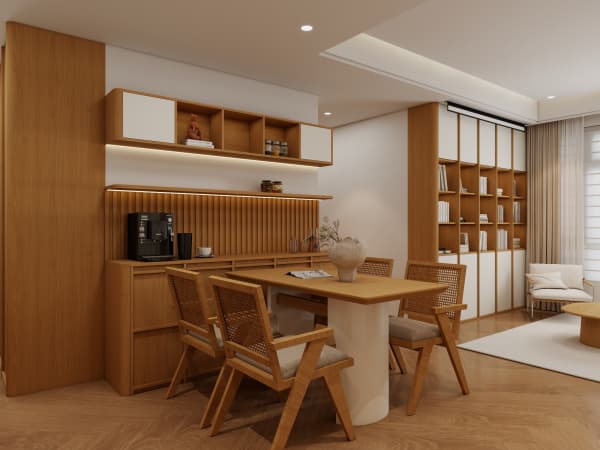
Custom beats ready when the space is odd or the need is specific. A built-in that wraps a bay window or fills a 1.2 m alcove uses space a shop piece wastes. For standard items like a bed or a side table, a bought piece often costs less and ships faster. Match the method to the gap.
Common questions about layered lighting plans
Warm or cool is a personal call, but keep it consistent. Most local kitchens read better at 4000K, a neutral white that shows food colour true without feeling like a clinic. Put the strips on a separate switch from the ambient so you can dim the room when the cooking is done and the talking begins.
Understanding reading a quotation in Singapore
A quotation should read like a bill of materials, not a single sum. Look for the board grade per cabinet, the edge type, the hinge brand class, the number of drawers, and the lighting. If an item is missing, assume the cheapest version, then decide. A clear quote also lists what is not included, like plumbing or hacking.
Where indoor air and board grade usually go wrong
The board grade decides what you breathe. In a sealed Singapore flat with the air-con on, a poor board off-gasses into a small space for weeks. E0 and ENF ratings are the local benchmarks, and the certifying body should be named on the certificate. Treat this as a health spec, equal to the hinge or the edge.
Every Bathroom Vanity in Singapore is a chain of choices, and the chain is only as strong as its weakest link. Get the permit, the plan and the people right, and the rest of the build takes care of itself.
One more point worth a line: keep the contact of the person who owns your project in a single note, with the quote, the permit and the warranty. When something needs a fix in year two, that note is what turns a denied claim into a quick visit. The paper you file today is the service you get later.
A small habit that pays off is to photograph the finished work at handover, before the furniture goes in. The shots show the edges, the gaps and the mitres as they should be, and give you proof if a fault appears after. Five minutes with a phone beats a week of argument about what changed.
Think about the next owner too. A clean, compliant build with the paperwork in order sells faster and for more, because the buyer's lawyer has fewer questions. The work you do for yourself also works for the resale, so treat the records as part of the asset, not just the receipt.
Do not chase the lowest number at the cost of the details. A job that saves on the edge banding and the hinge shows it within a year, and the fix costs more than the saving. Spend on the parts you touch daily, and the home feels right long after the photos are taken.
Finally, give the build a week before you judge it. Wood settles, doors find their rest, and a small adjustment at the start of use prevents a bigger one later. A carpenter who returns for the punch-list is worth more than one who disappears the day the balance is paid.
Match the build to how you actually live, not to a showroom you visited once. The kitchen you cook in and the wardrobe you open daily should reflect your routine, because a home that fits your habits is the one you stop noticing, and that is the highest praise a renovation can earn.