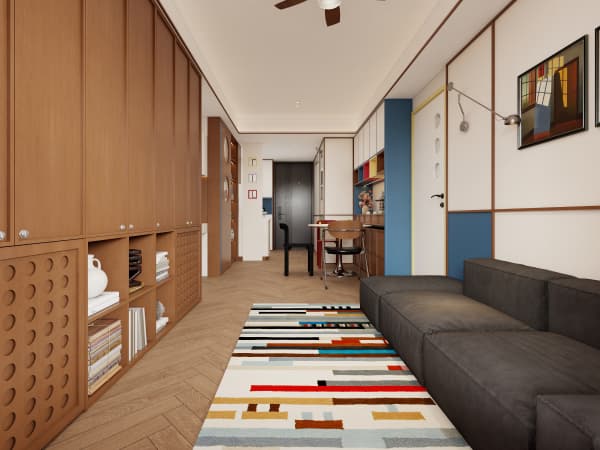
Custom Furniture for maisonette: A Music Corner That Damps
Custom Furniture for an HDB maisonette should carve a music corner on the upper floor where a damped, built-in cabinet keeps your practice from travelling to the neighbours downstairs, and the smartest version wraps the instrument in mass and soft material instead of leaning panels against a party wall. In a two-level HDB the stairs already separate you from the flat below, but footfall and low notes still find the slab.
Custom Furniture for a maisonette music corner starts with the wall
Maisonettes are rare now but they exist in pockets of Bedok, Toa Payoh and Bukit Batok, and their quirk is the half-landing and the upper bedroom floor that sits above the neighbour's ceiling. Sound moves through the slab, so a corner on the upper level is better than one above the living room, but you still need mass. A custom cabinet built with a plywood carcass lined on the inside with 25 to 50 mm acoustic foam, plus a heavy MDF back, adds the weight that soaks a guitar amp's low end better than any freestanding stand.
Keep the cabinet off the party wall if you can; the shared wall is the one your neighbour hears most. Float it 20 mm on rubber pads so vibration does not couple straight into the structure. HDB's noise rules are about amplified sound and timing, not a decibel licence for your home, but a considerate build means you are not the flat the RC hears about at 9 pm.
What actually damps, and what is theatre
Eggshell foam alone does little for bass; it only tames echo in the room. Real damping is mass and airtightness. A custom music corner that works has a solid door or flap, sealed edges, and dense infill behind the back panel. Fabric-wrapped acoustic panels on the open face look studio-grade and catch the mid-range, which is what makes your own playing clearer even with the door open.
For a keyboard or a quiet guitar, you do not need a full booth. A 90 cm wide by 2 m tall cabinet with a fold-down desk for the synth, foam-lined sides and a fabric front that zips or lifts is enough, and it reads as a normal piece of carpentry in a 110 sqm 5-room-style maisonette. Build the infill from offcuts of your other carpentry and the added cost is small, often S$600 to S$1,200 for the damped shell.
Power, stands and the stairs problem
Maisonettes mean stairs, and a piano does not walk up them easily. Spec the cabinet for the gear you already have, not the grand you imagine. A custom stand built to the instrument's footprint, with a recessed power strip and a cable chase to the floor, keeps the corner safe for kids and tidy for you. Leave 10 cm behind the cabinet for airflow if you run an amp, because Singapore heat shortens electronics faster than the music justifies.
Carpentry lead time for a piece like this is the usual 6 to 10 weeks, so brief it while the rest of the reno is still at tiling stage. A one-year defect warranty should cover the hinges and the foam fixings; the foam itself is a consumable, so ask what is covered in writing before you sign.
Pick the upper corner, build mass into the back, and seal the edges, and you get a music space that lets you play late without a knock on the door. The maisonette's split level becomes the feature, not the problem, and the gear finally has a home that sounds as good closed as it looks open.