Custom Furniture of shophouse: A Switch That Fits the Hand
Custom Furniture inside a conserved shophouse should put the light switch exactly where your hand falls, not where the original 1920s wiring happened to end, and a shallow custom panel let into the new carpentry is how you get there without touching the protected facade. In a Singapore shophouse the front wall is usually off-limits, so the fix lives in the furniture you are allowed to build.
Custom Furniture inside a conservation shophouse lives by the rules
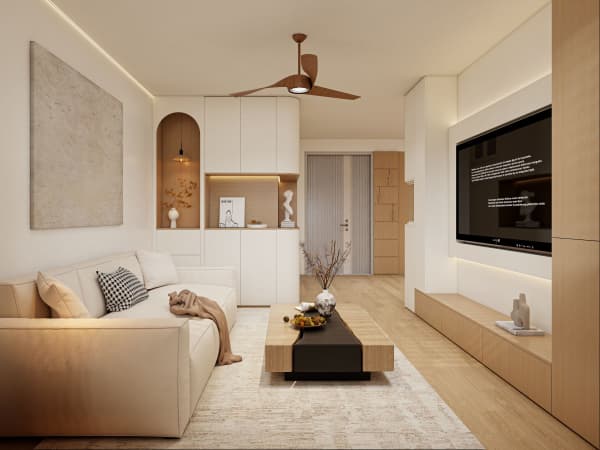
URA conservation shophouses, whether in Joo Chiat, Tanjong Pagar or Geylang, protect the front elevation, the stairs and often the internal party wall. You cannot chase a new conduit into those surfaces, and you certainly cannot widen a window to improve the view. What you can do is build free-standing or wall-mounted carpentry that carries its own services. A reading nook or a bar counter can hide a surface-mounted trunking behind a 5 cm shadow gap, and the switch plate sits flush on the new panel, not on the conserved plaster.
This matters because the conserved wall is rarely straight. A custom panel scribed to the skip means the switch never wobbles in a 4 mm gap, and you avoid the tell-tale patched circle that a retrofitter leaves. Tell the carpenter the exact make of the switch, most Singapore homes use the standard 86 by 86 mm plate, so the cut-out is millimetre-right the first time, not re-cut on site.
Routing power without breaking the conservation bond
Power for the panel runs from an existing point, normally a ceiling rose or a skirting outlet, via surface trunking painted to match. Keep the run short and tidy; a long visible conduit reads as cheap even when it is compliant. For a shophouse, the five-foot-way side often has more freedom than the front, so route the new switch loop from the rear service area where the conservator will never look.
Condo-style MCST rules do not apply to shophouses, but your own conservation consultant and the builder will, and a wrong chase can void the grant or the permit. Budget the power routing as a separate line item, roughly S$300 to S$700 for a tidy short run with a licensed electrician, and never let the carpenter just drill through a wall that is on the protected list.
Matching the panel to shophouse character
The fun part is the face. A shophouse rewards honest material: solid teak or chengal for the panel, a brass switch plate, perhaps a small terrazzo inlay that echoes the original floor. Solid wood costs more and moves with Singapore's humidity, so ask for a stabilised board, plywood core with a timber veneer, where the panel is large, and reserve solid timber for the thin lip you actually touch. The switch should sit at about 100 to 110 cm off the floor, the comfortable hand height, not the 120 cm you sometimes see in commercial fit-outs.
A custom panel also hides the awkward: the old bell wire, the duct, the scar from a previous tenant. Build it 4 to 6 cm proud of the wall and you gain a shadow line that looks intentional and a cavity that swallows the mess. Whole-home custom work in a shophouse runs higher than an HDB because of the conservation overhead, often S$50k to S$90k for a full floor, but a single hand-fit switch panel is a few hundred dollars that makes the whole place feel considered.
Get the conserved surfaces mapped before you brief the carpenter, decide the switch height with your own hand on the wall, and the result is a shophouse that respects its bones while finally working the way you reach. The facade stays untouched, the grant stays valid, and the light comes on exactly where your fingers expect it.