Custom Furniture of landed home: A Nook That Hides Wires
Custom furniture for a landed home can hide wires in a built nook. It's a recess with routed channels behind a plain front, so your TV, router, and speaker cables vanish instead of running down the paint in a house where gear piles up fast.
Why landed homes collect cables
A landed house spreads rooms across more walls than a flat, so entertainment, networking, and lighting gear multiply. Custom furniture gives each run a home instead of a tangle.
What the nook delivers:
Hidden routes – cables run inside the panel, not across the wall.
Easy access – a removable back lets you swap a box without ripping things open.
Clean facia – the front stays a plain surface, no sticky trunking in view.
Future-proofing – extra channels mean the next device just drops in.
In a 4-room HDB of roughly 90sqm you'd rarely need this, but a landed home with a media wall absolutely does.
Materials that hide and last
The nook backs a lot of heat and handling, so the board choice matters.
Plywood takes the routed channels cleanly and stays rigid behind the TV.
MDF with laminate gives a smooth, wipeable face and hides the cuts well at lower cost.
Solid wood looks rich for a feature nook but needs care near electronics' warmth.
For a wire nook, plywood core with a laminate front is the practical, tidy answer. Leave a small gap at the back for airflow so the gear doesn't cook.
How Custom Furniture cleans the wall
Custom furniture cleans the wall because the maker routes the exact paths your devices need. Off-the-shelf units assume one hole; your home has six cables and a power strip.
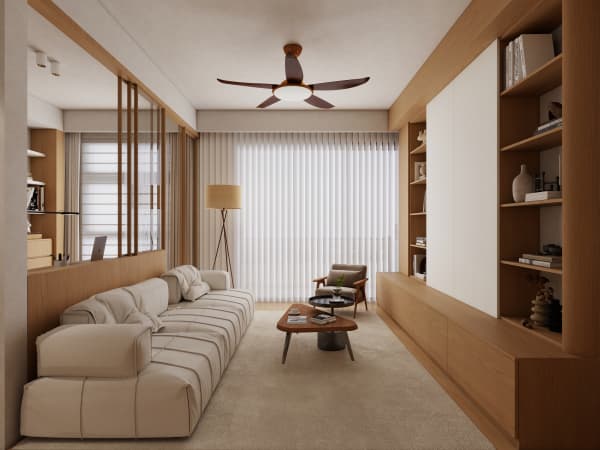
The 2025-2026 habit in landed homes is a clean media wall with gear tucked away, and a wire nook delivers that look without trunking down the paint.
In a landed home near 110sqm and up, the nook often sits in the living or study wall, reclaiming a clean look that helps at resale. Note HDB and condo rules differ – a landed owner faces no MCST, but still keeps to building guidelines for structural walls.
Add a shallow ledge above for the router and a vented door, and the whole stack disappears behind one quiet panel.
Timeline and what it costs
From measure to install, a wire nook takes about 6 to 10 weeks. The maker maps the devices first, then builds to that map, so bring your boxes to the site visit.
Costs run roughly S$500 to S$1,800 depending on size and how many channels you need. Against a landed reno budget that often exceeds the S$30k to S$70k flat range, it is a small line that removes daily eyesore.
Insist on a 1-year defect liability period. If a door sags or a channel cracks within that year, the maker should return and fix it at no cost.
Keeping the nook working
Care is light. Dust the vents every few months, check that cables aren't pinched when you close the door, and label the leads so a future swap takes minutes.
Wipe the laminate with a damp cloth and avoid spraying cleaner straight at the seams. Most hardware lasts years with that little attention.

Homeowners tell us the nook is the one piece visitors never notice – and that's the compliment. Walk in, see a clean wall, and only you know the tangle it's hiding behind.