HDB Renovation: edge profiles that resist chips
HDB Renovation is where your carpentry actually lives or dies, and the part that fails first is almost never the board. It's the edge. A cabinet door or a kitchen cabinet that looks flawless on handover day can start chipping at the corners within a year if the edge profile and banding aren't up to the job. Get this right early and your cabinets stay sharp-looking well past the typical reno warranty.
Why edges chip in the first place
Most HDB carpentry is built from moisture-resistant boards finished with a decorative surface. The board itself is solid enough, but the exposed edge is the weak seam. In a Singapore home, that seam takes a beating from daily life. Think wet hands in the kitchen, the occasional knock from a pail, humidity swings, and the simple friction of opening and closing doors thousands of times a year.
The reason edges fail is usually one of three things:
- The banding material is too thin or too soft for the spot it's used in.
- The glue line wasn't sealed properly, so moisture creeps in and lifts the edge.
- The profile has a sharp, exposed corner that takes the full impact of every bump.
None of these are about the brand of the board. They're about how the edge is finished, and that's a choice your contractor makes during fabrication.
The main edge banding types you'll meet
Walk into any carpentry workshop and you'll hear a few terms thrown around. Here's what they mean in plain English and how they hold up.
- PVC edge banding — the most common choice. It's a plastic strip heat-glued to the edge. Good PVC at 1mm to 2mm thickness resists knocks well and is easy to clean. Thin 0.4mm stuff looks fine at first but peels faster.
- ABS edge banding — similar look to PVC but a bit more durable and less prone to yellowing. A solid pick for kitchen and bathroom-adjacent carpentry where heat and moisture are constant.
- Acrylic or 2mm solid edge — thicker, stronger, and gives that seamless, premium look on the front edges of cabinets. It costs more but takes impact far better.
- Exposed raw edge (no banding) — sometimes seen on internal shelves. Fine for the inside of a wardrobe, never for a visible, handled surface.
Profiles that actually resist chipping
The shape of the edge matters as much as the material. A sharp 90-degree corner is a magnet for chips because the whole impact lands on a tiny point. Softer profiles spread that force out.
- Rounded or bullnose edge — the front edge is slightly curved. Bumps glance off instead of biting in. This is the workhorse profile for kitchen cabinet fronts and island counters.
- Beveled edge — a small angle cut on the top front corner. Looks tidy and reduces the chance of a clean snap at the corner.
- Full 2mm ABS or acrylic square edge — if you want a crisp, modern look, go thicker rather than thinner. The extra mass absorbs hits.
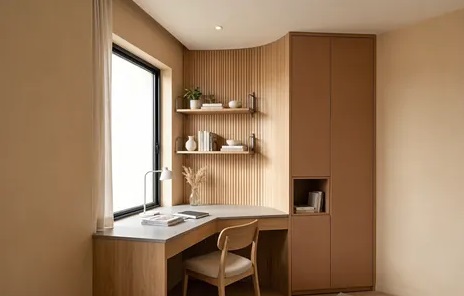
For most HDB kitchens and bathrooms, a rounded 2mm edge on the front-facing parts is the sweet spot. Keep the thinner banding for hidden internal shelves where nobody touches the edge.
Where to spend on better edges
You don't need to upgrade every single edge in the flat. Spend the money where the action is.
- Kitchen cabinets and drawers — highest traffic, most moisture, most knocks. Use thick ABS or acrylic here without question.
- Bathroom vanity and nearby carpentry — humidity is relentless, so sealed edges are non-negotiable.
- Wardrobe doors at bed height — these get pulled open daily and bumped by laundry baskets.
- Study tables and TV consoles — the front edge takes elbows and remotes.
Internal wardrobe shelves and the back of cabinets can stay with standard PVC to keep the budget sane.
Questions to ask before you commit
Don't wait until installation to find out what you're getting. When you discuss carpentry, pin down the specifics so there's no guessing later.
- Ask what thickness and material the edge banding is on visible surfaces — get it written into the quotation.
- Confirm the front edges of kitchen and bathroom carpentry use at least 1mm to 2mm sealed banding.
- Request rounded or beveled profiles on high-contact edges instead of raw sharp corners.
- Check a sample door edge yourself. Run a fingernail along it; if the banding lifts or shows a gap, that's your answer.
Since 1 October 2024, the CaseTrust Renovation Framework applies to contracts of S$5,000 and above and requires itemised "Open Book" pricing. That means your edge specification should show up as a line item, not buried in a lump-sum carpentry cost. If it's not itemised, ask for it.
Small detail, long payoff
It's easy to obsess over door colours and forget the edge, but the edge is what your eye catches every single day. A chip-free, sealed profile keeps the whole cabinet looking new and saves you from the annoying job of re-gluing lifted banding later. When you're planning whole-house customization for your HDB flat, treat edge profiles as a quality marker rather than an afterthought. Specify them, see them in the sample, and you'll get carpentry that holds up to real Singapore living.