HDB Renovation: adapting a flat for elderly parents
HDB Renovation to welcome ageing parents is mostly about removing risk: steps, slips, and poor light. The changes that matter most are not the pretty ones but the practical ones, and done early they let your parents stay independent in their own home for years longer.
Step-free paths are the foundation
The single biggest hazard for seniors is a change in floor level. Within HDB's hacking rules you can still flatten the main routes so a walking frame or wheelchair rolls without a jolt.
- Keep the bedroom-to-toilet path on one continuous floor with no raised thresholds.
- If a toilet sits slightly lower, ramp it gently with a slip-resistant transition rather than a hard step.
- Leave at least 900mm of clear width so a frame or helper can pass comfortably.
Remember you cannot hack the parapet wall or floor trap, and toilets cannot be shifted, so the layout has to work around what is already there. That is fine. Most adaptations are flooring and fittings, not demolition.
Grips and support where they are needed
Falls happen in the places you least expect, so put support where hands naturally reach. Grabrails are not a hospital look if you choose a warm finish that matches the tile.
- Fit a rail beside the toilet and one in the shower, both rated for the user's weight.
- Add a fold-down seat in the shower so long baths are not exhausting.
- Place a rail at the bedroom entry and any spot where balance is needed at night.
- Use lever taps and door handles that open with a push, not a twist.
These fittings are cheap relative to a hospital bill, and they are the kind of detail a good contractor installs without you having to chase them.
Lighting that fights failing eyes
Older eyes need more light and less glare. A flat lit for a thirty-year-old will feel dim and shadowy to a seventy-year-old, and shadows are where trips start.
- Use warm, even LED light in corridors and the toilet, around 3000K to 4000K.
- Add motion-sensor night lights so a 3am walk needs no fumbling for a switch.
- Put a task light at the bedside and the favourite chair for reading.
- Avoid harsh downlights that throw hard shadows on the floor.
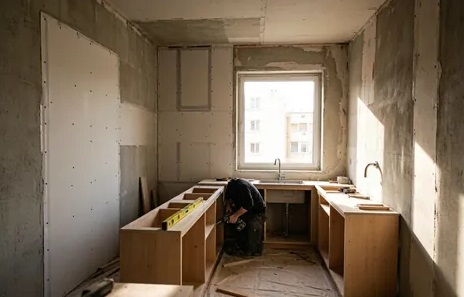
Layer the lighting so the whole path is bright, not just one bright spot with dark edges. That even spread is what keeps a senior confident moving at night.
Surfaces and fittings for safer days
Choose materials that forgive. Matte, non-slip flooring in the wet areas, rounded cabinet edges instead of sharp corners, and pull-out shelves so nothing is lifted from a deep base. Rounded edges matter more than they sound when someone leans or loses balance.
Also lower one section of the kitchen counter if your parent still cooks, and keep the microwave at a height that does not need reaching overhead. Small changes, big difference to daily dignity.
Making the home ready for the years ahead
Adapting a flat for elderly parents is not a one-weekend job; it is a quiet investment in their independence. Do the step-free paths, the rails, and the lighting now, and the home grows old with them instead of against them. When you plan the carpentry and fittings, whole-house customisation lets you build these supports in cleanly rather than bolting them on later, which is kinder on both the look and the budget.