Condo Fit-Out Singapore: A simple path to Simei
Search trends show that a Condo Fit-Out in Singapore is one of the most searched home projects, yet few guides explain the order of works clearly. This piece walks the sequence the way local builders actually run it.
How choosing a contractor affect your schedule
Pick a contractor on evidence, not a flyer. Ask for two recent jobs you can visit, check the warranty terms, and read the contract for the payment schedule. In Singapore, a registered firm with a showroom is easier to hold accountable than a one-man team you found on a messaging app.
What open kitchens and town gas cost you in the end
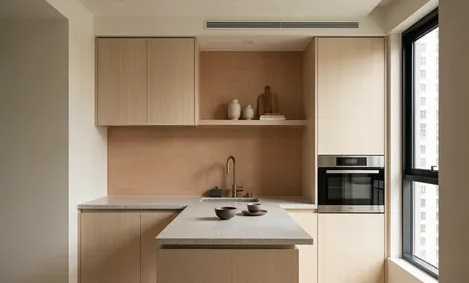
An open-concept kitchen looks great until you learn the rule. In Singapore, the town gas supply runs through a piped network, but if you remove the wall that encloses the kitchen, the gas supplier will terminate the piped supply. The fix is an induction hob, which needs no gas and suits the open layout without the cut-off.
How typical carpentry budgets affect your schedule
Most owners under-budget the hidden parts. Edge banding, soft-close hinges, pull-out trays and lighting strips add 15 to 30 percent on top of the quoted carcass. Ask for these as line items, not a single round figure, so you can see where the money goes. A quote that bundles everything into one sum hides the choices you might cut.
What plywood for wet areas cost you in the end
The weak point of any board is the edge. Even plywood swells if the laminate edge peels, so ask for PVC or ABS edge banding that is glued and not just stuck on. In a landing where the dishwasher leaks, sealed edges buy you years. Pair the board with a backsplash that goes at least 600 mm up the wall and the cabinet legs stay dry.
The numbers matter: a a landed corner terrace with a balcony extension and a S$8,000 cap still gets a full plywood base and soft-close fittings if the owner cuts the face-grade and keeps the inside honest. The feel stays, the cost drops.
How maximising cabinet storage affect your schedule
Think vertical. The dead space above the upper cabinets and the gap under the sink are free real estate. A slim trolley that slides into a 150 mm void beats a wide one you cannot open. Measure the awkward corners first; the right filler drawer uses a space a standard cabinet wastes.
How layered lighting plans shape the final result
Plan the lighting before the carpenter measures, because the power points and the profiles must be built into the cabinet. Retrofitting a strip after the boards are up means visible wires or a rebuild. Tell the carpenter your light plan on day one, and ask where the driver hides so it stays serviceable.
Where condo MCST renovation rules usually go wrong
Condos in Singapore answer to the Management Corporation (MCST), and the MCST sets the rules. Expect a renovation deposit, a defined work window of roughly 09:00 to 18:00 on weekdays, and no noisy works on Sundays and public holidays. Some developments also restrict lifts and require protective hoarding in the lobby. Read the by-laws before you sign the carpenter, not after a stop-work order.
How renovation stages in order affect your schedule
Hold a weekly site check at each handover. When the tiler leaves, walk the floor for hollow tiles. When the painter leaves, check the edges. Catching a fault before the next trade covers it saves a fight later. The stage checks are the cheapest insurance in the whole job.
In Simei, a a landed corner terrace often comes with an awkward service yard, and the build that works treats it as a second kitchen rather than a dump. A S$50,000 budget stretches further when the yard pulls its weight.
A practical view of reading a quotation

Watch the variation clauses. A quote at S$15,000 that becomes S$22,000 after 'unforeseen' items hurts more than a S$19,000 firm quote. Ask what triggers a variation and cap it in writing. Most reasonable carpenters will agree to a 10 percent ceiling if you ask before signing.
Getting HDB renovation timelines sorted early
Most homeowners underestimate the punch-list. Even a smooth job leaves a week for touch-ups: a misaligned door, a chipped edge, a drawer that sticks. Build that buffer into your move-in date. If you rent while renovating, align the lease end with the buffer, not the theoretical finish line, or you pay double for a place to stay.
For anyone starting a Condo Fit-Out in Singapore, the lesson is simple: slow at the front, steady through the middle, careful at the end. The owners who follow that rhythm are the ones who never redo the job.
One more point worth a line: keep the contact of the person who owns your project in a single note, with the quote, the permit and the warranty. When something needs a fix in year two, that note is what turns a denied claim into a quick visit. The paper you file today is the service you get later.
A small habit that pays off is to photograph the finished work at handover, before the furniture goes in. The shots show the edges, the gaps and the mitres as they should be, and give you proof if a fault appears after. Five minutes with a phone beats a week of argument about what changed.
Think about the next owner too. A clean, compliant build with the paperwork in order sells faster and for more, because the buyer's lawyer has fewer questions. The work you do for yourself also works for the resale, so treat the records as part of the asset, not just the receipt.
Do not chase the lowest number at the cost of the details. A job that saves on the edge banding and the hinge shows it within a year, and the fix costs more than the saving. Spend on the parts you touch daily, and the home feels right long after the photos are taken.
Finally, give the build a week before you judge it. Wood settles, doors find their rest, and a small adjustment at the start of use prevents a bigger one later. A carpenter who returns for the punch-list is worth more than one who disappears the day the balance is paid.